

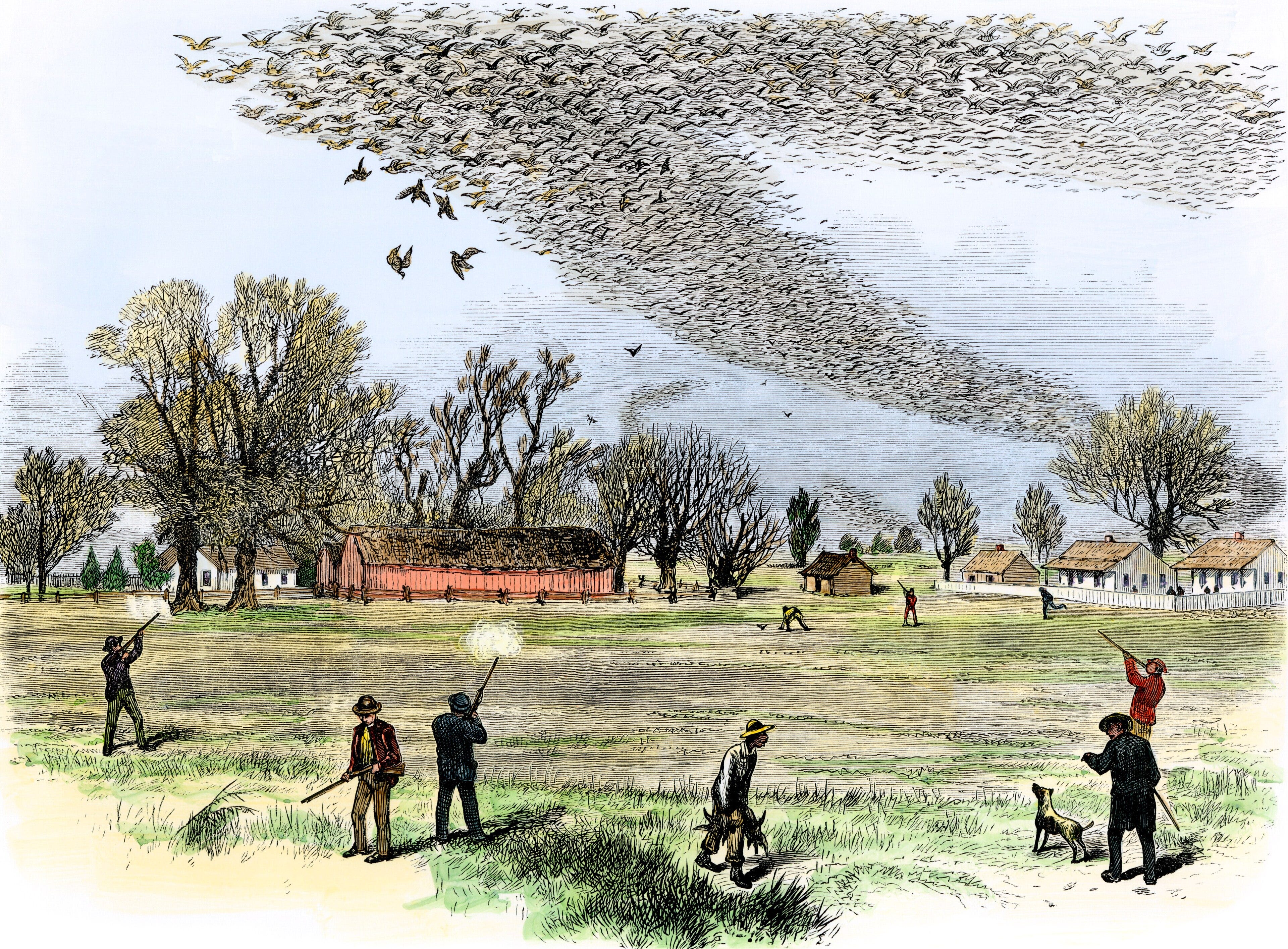
“Viewed from all angles, the passenger pigeon was the most impressive species of bird that man has ever known.” ~Aldo Leopold
Deep down off County Road BB in southern Wisconsin is a place I know so well. This little patch of bottomland hardwood forest shaped everything about me. The rich almost black soil slopes steeply down to the Crawfish River, a slow, muddy tributary of the Rock River. Probably 60% of my weekends as a child were spent in these bottomlands. The little two bedroom (no bath) house had a black-and-white TV with rabbit-ear antennas. A bunk bed. The outhouse was on top the hill. And many many mosquitos. We called it ‘the river cottage’.
I passed most my time here chasing catfish, walleye, and pike on the river, and sometimes organizing my voluminous but virtually valueless baseball card collection. On hot summer days, when the fishing was bad, I would play beneath the canopy of the large bur and white oak trees. When I got older, I read magazines and books under these trees. Some of them were enormous - I think at least 150 years old. I used to marvel at the size and weirdness of the bur oak acorns. I know this land so well.
Yet somehow, it wasn’t until I was a grown adult that I learned anything about the passenger pigeon. This species, now extinct, very likely once graced the limbs of these same trees when they were younger trees. And not just a few birds. Potentially thousands, tens of thousands, perhaps more, passing overhead or roosting in these branches. And now the bird has vanished.
We think we know places.
Today, on the 112th anniversary, I want to share some of the astounding details behind the extinction of the passenger pigeon in North America. It is a super sad story, and while it seems old, and told many times before, it remains an important cautionary tale. This is a fundamentally modern story - one about our extractive relationships with nature.
And it is never too late to learn.
Meet the Passenger Pigeon - A Bird of Billions
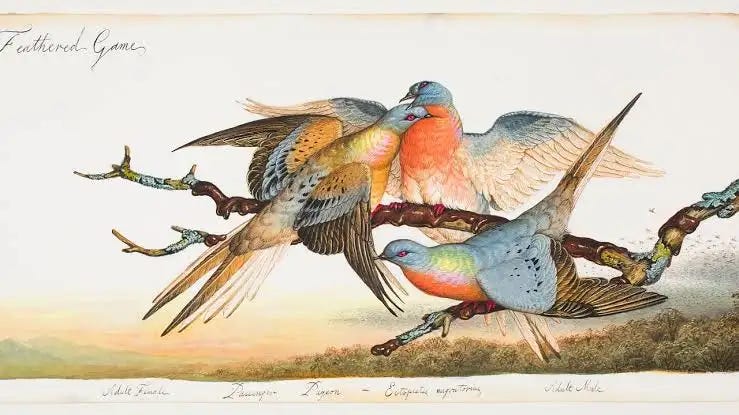
For millennia, passenger pigeons probably appeared to people less like wildlife, and more like weather or an extraterrestrial sighting. These animals moved across eastern North America in numbers genuinely difficult to comprehend. Estimates vary, but before their decline there may have been 3-5 billion passenger pigeons alive at once.
Five billion…
This makes the passenger pigeon the abundant bird species known from historical records. If you lined the five billion birds up, they would have circled the Earth roughly 23 times.
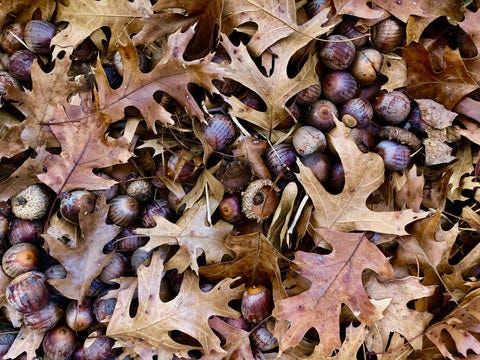
Passenger pigeons were intensely social and nomadic. They were constantly on the move, probably because they depended heavily on tree nuts and tracked masting events across hardwood forests of eastern North America. Trees, it turns out, do not produce a similar number of nuts every year. Networks of nut-producing forest trees synchronize enormous crops of acorns, a phenomenon called “masting.” Masting is poorly understood by scientists, but one explanation is that by occasionally producing far more seeds than rodents, squirrels, deer, birds, and other hungry animals can possibly consume, enough seeds escape and become little trees. This masting phenomenon is fascinating on its own. But in the story of the passenger pigeon, the trees and birds were intimately linked. There was a synergy there. Beechnuts and acorns, especially, provided the pulses of food needed to feed the pigeon hordes.
Long before Europeans named the passenger pigeon, Indigenous peoples across eastern North America had their own names for the bird. The Lenape called it ‘amimi’, the Ojibwe ‘omiimii’, and the Kaskaskia Illinois ‘mimia’. In Mohawk it was ‘ori'te’, while one Choctaw name, ‘putchee nashoba’, has been translated to mean lost dove. The Seneca called it ‘jahgowa’, or big bread - a name that speaks to its nourishing role.
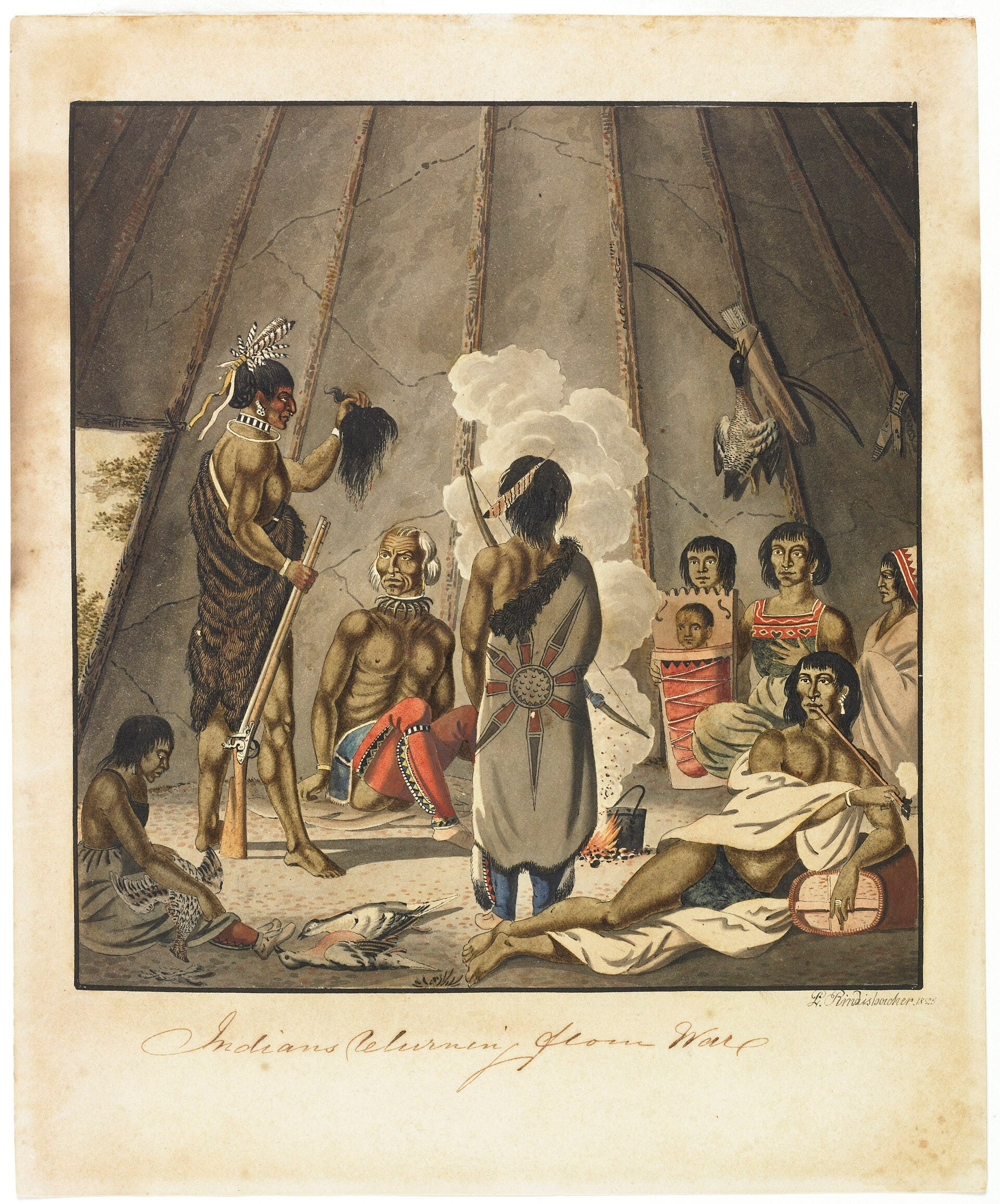
But all peoples who interacted with the pigeon across cultures shared one important thing in common. No one, at all, knew when or where these birds would actually appear. A place could suddenly be completely inundated with pigeons and then see few or none for years. That unpredictability may have helped prevent overharvest from becoming systematically destructive for much of human history.
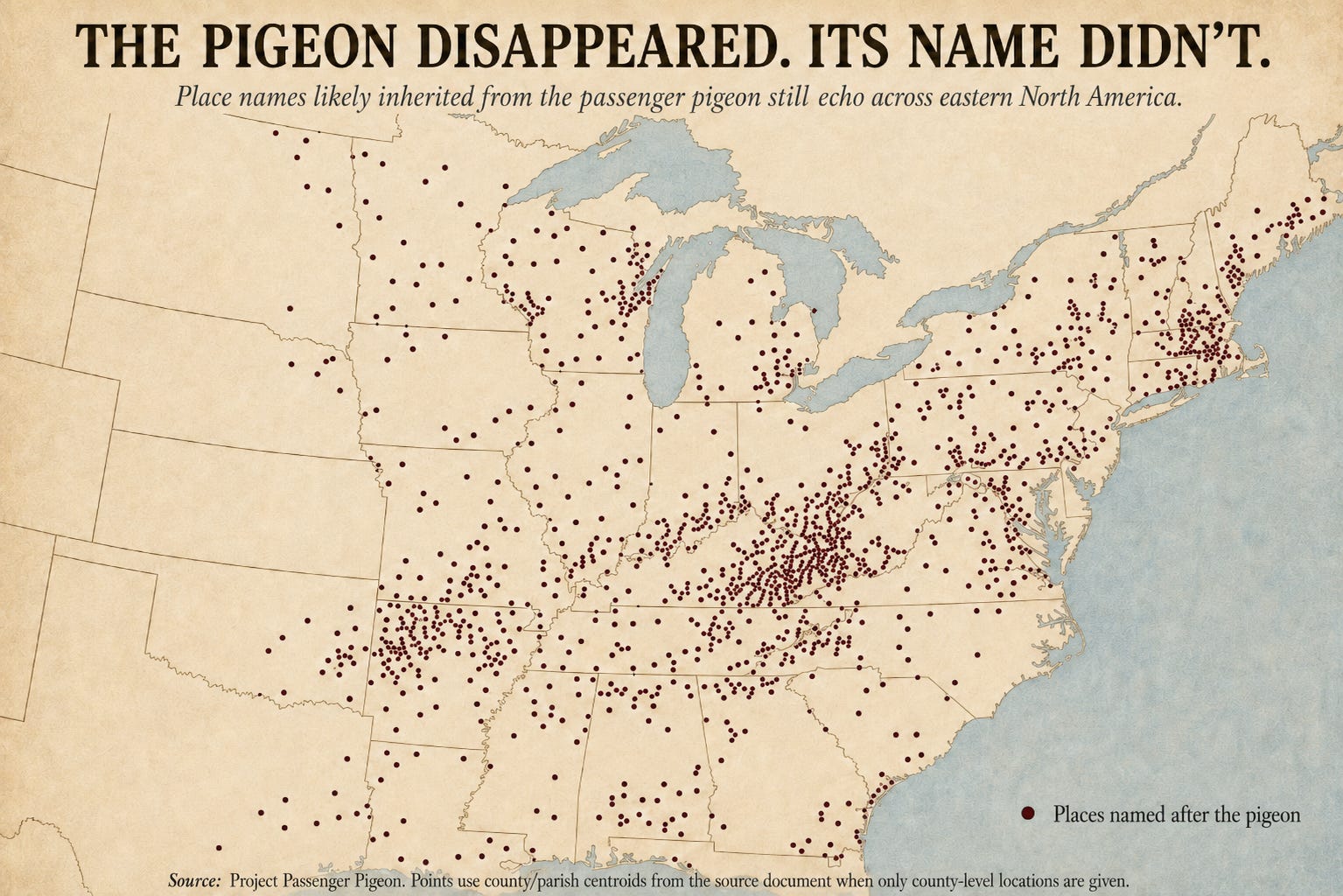
It is perhaps for these reasons that there are so many places across the Eastern US named after the pigeon.
“I beheld moving toward me in an unbroken front millions of pigeons.” ~Simon Pokagon, Potawatomi leader, recalling the Great Lakes
“The air was literally filled with Pigeons; the light of noon-day was obscured as by an eclipse.” ~John James Audubon, Kentucky, 1813
“The living torrent above my head seemed as numerous and as extensive as ever.” ~Alexander Wilson, Kentucky, early 1800s
Again and again, witnesses reached for the language of storms, rivers, and celestial events because ordinary descriptions of birds were inadequate.
The nesting colonies were especially remarkable. Historical breeding grounds covered gargantuan areas. One nesting event in west-central Wisconsin in 1871 occupied an estimated 850 square miles, or about 544,000 acres, and may have contained upwards of 136 million breeding adults. Elsewhere, observers described forests where tree after tree was jammed with nests, sometimes dozens in a single tree. And despite all this abundance, the passenger pigeon was not an especially prolific breeder. A female typically laid just one lone egg per year.
Imagine what millions of birds arriving at once would have done to a forest.
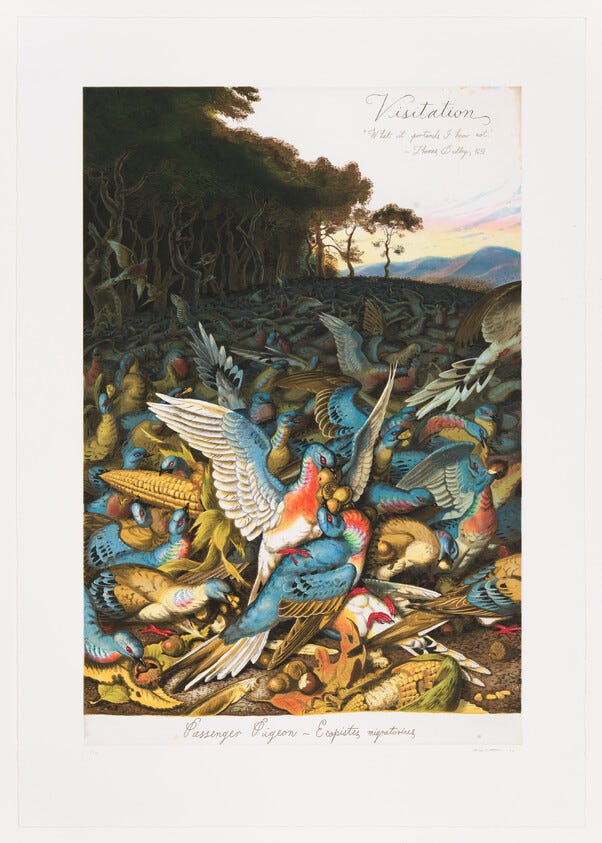
Wings roaring overhead. Branches bent, sagging and breaking from the crowded roosts. Trees packed with nests. Droppings accumulating on the forest floor like a layer of liquid snow. When the birds descended to feed, the ground itself probably looked like it was moving.
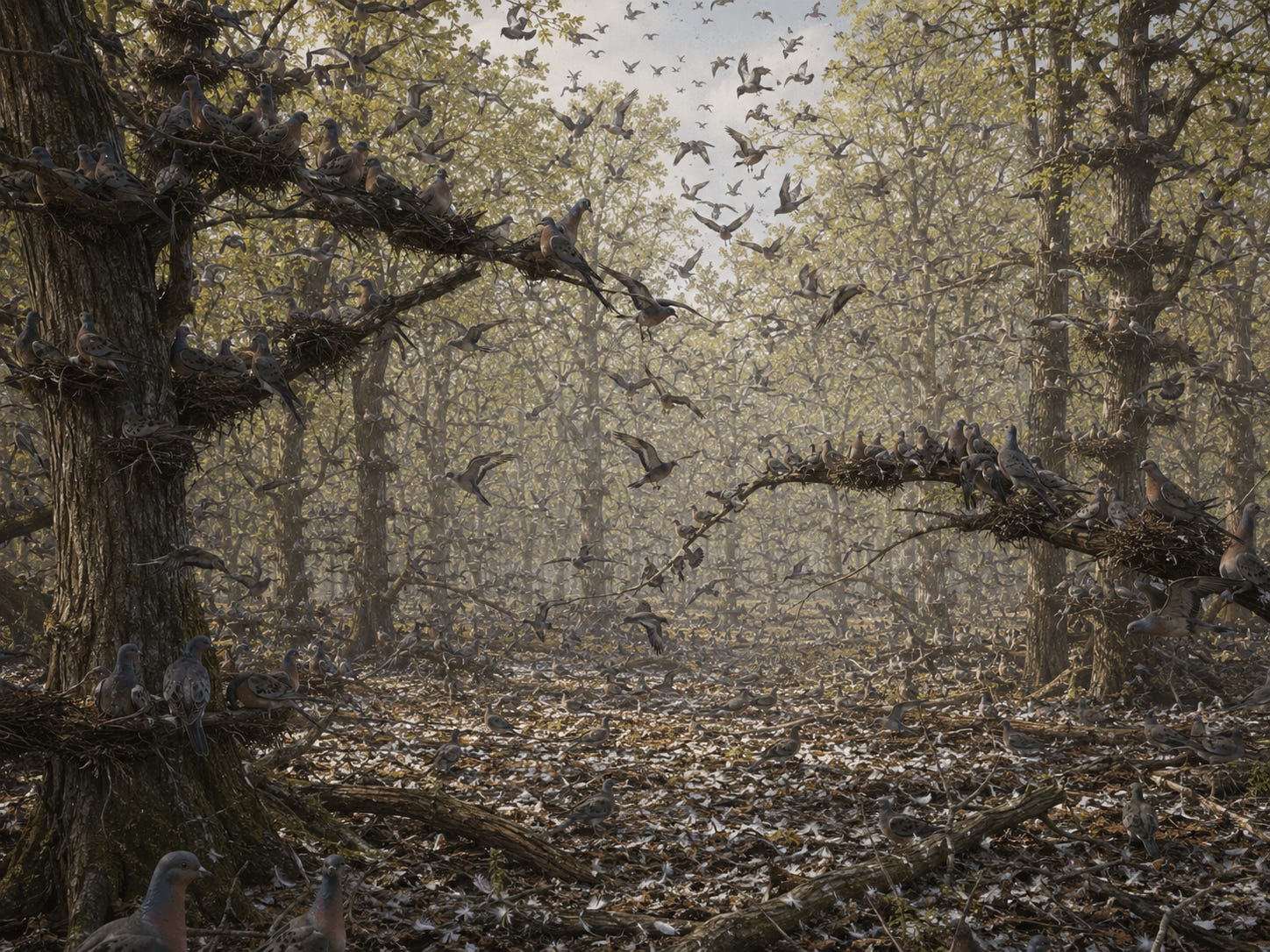
The ecological effects must have been truly impressive. And I don't think we understand quite yet all of what they did. Passenger pigeons transferred massive quantities of nutrients into forests and, inevitably, into nearby streams, rivers, and wetlands. Their feeding, roosting, nesting, and poop altered entire forest patches. Severe physical disturbance likely resembled tornadic or intense fire effects, top-killing much of the vegetation, adding nutrients to the soil, and creating the high-light conditions that favor intermediate tree species such as oaks and white pine.
To this fish ecologist, there is something strangely familiar about this ecology. It reminds me of the riparian forests along great salmon streams, where huge numbers of animals move nutrients across ecosystem boundaries and fundamentally augment landscapes. Passenger pigeons were ecosystem engineers of the eastern forests. At sufficient abundance, they were helping create those forests, suppressing certain species, and encouraging others.
And therein lies the problem.
To the people who lived among them, passenger pigeons were so abundant that their permanence seemed inevitable. How could something measured in billions ever disappear?


Technology and the Decline of the Passenger Pigeon
Passenger pigeons survived Indigenous harvest and natural fluctuations in food and climate for millennia. Their obvious advantage was their sheer numbers. By moving, feeding, roosting, and nesting in enormous groups, they overwhelmed ordinary predators and rapidly exploited masting events of acorns and beechnuts across huge areas. They could also engineer the ecosystems to be more favorable for pigeons.
But that same strategy became a liability once humans developed the tools to effectively exploit the flocks. During the nineteenth century, several technologies converged that spelled doom for the pigeon. It was especially during the period between the end of the Civil War and the turn of the century where the problems took root fast.
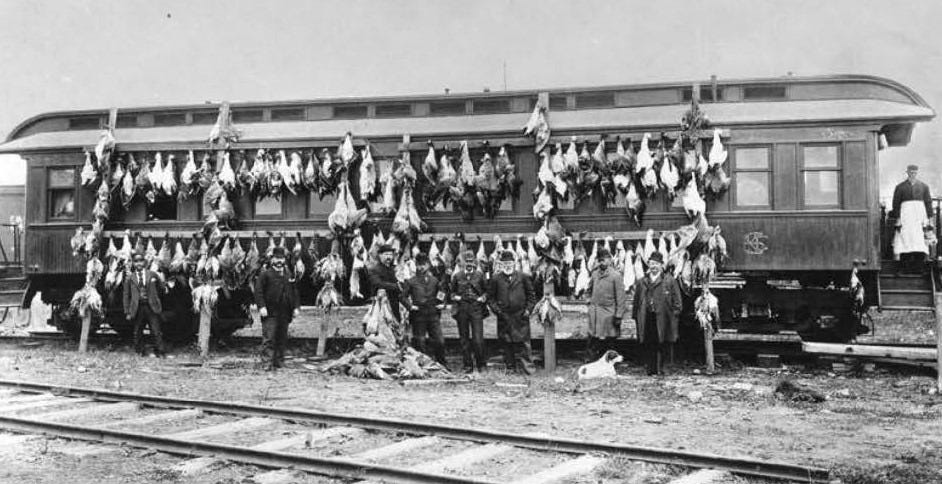
Railroads suddenly made remote nesting colonies highly accessible. More critically, the telegraph allowed for instantaneous transmission of locations of the enormous aggregations. And there was money at stake. Better guns, nets, and other harvesting methods increased the efficiency of killing. Meanwhile, expanding cities and commercial markets created demand far beyond the communities where the pigeons appeared.
And once the birds were killed, the railroads completed the circuit, carrying barrels and wagonloads of pigeon carcasses to distant markets.
Market hunting became a legitimate profession. “Pigeoners” (professional pigeon hunters), numbering in the tens of thousands, followed reports of nesting colonies and large flocks from place to place, sometimes traveling great distances to kill them. What had once been an unpredictable natural bounty could now be located, communicated, reached, harvested, and sold.
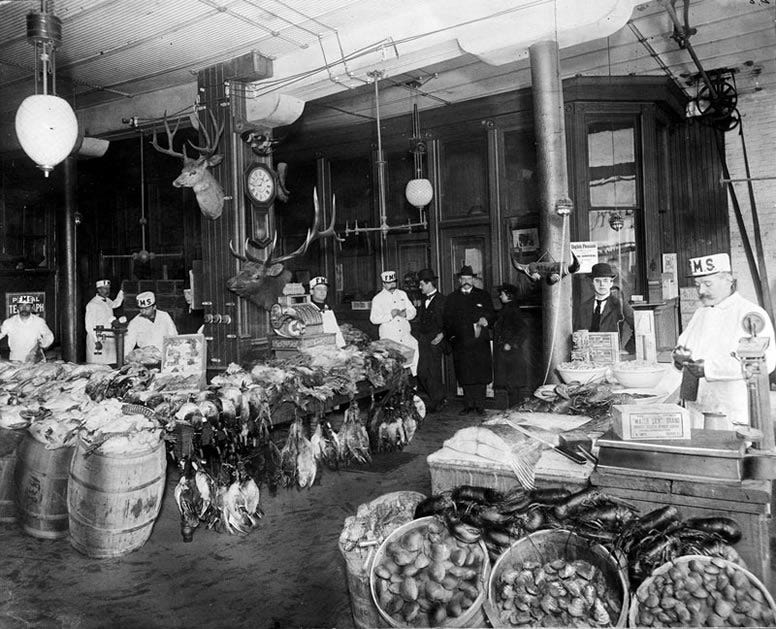
Quite suddenly, a nesting colony containing millions of birds was no longer a spectacular natural event. It was a concentration of food and protein to be located and monetized. And to add further insult, the forest landscape of the eastern US was being rapidly denuded and converted into agricultural fields; thus the roosting habitats and trees (along with their nuts) were disappearing.
The passenger pigeon evolved to survive predation through abundance. There were simply too many birds, spread across too much country, moving too unpredictably, for ordinary predators to matter very much. But humans of the industrial age were not ordinary predators.
The superpower of the passenger pigeon was now its weakness.
The Abundance Trap, Defined
It is ultra tempting to crane back at nineteenth-century America and wonder what on Earth they were thinking. How could people see passenger pigeons moving across the landscape in flocks of millions, kill them by the tens and hundreds of thousands, at a clip and not understand where it might lead?
Part of the answer is cultural. At the time, people were much more accustomed to this kind of behavior. Life was hard, and hunting wildlife, including market hunting, was a major part of American culture.
But another part of the answer was psychological. America’s natural resources at this time, including the passenger pigeon, were largely viewed as limitless.
“This great nation...cradled between two oceans with inexhaustible resources...” ~Henry Ward Beecher, Fort Sumter, 1865
This is, in a nutshell, what I term “the abundance trap.”
Humans have an innate tendency to conflate abundance and stability. When something is extremely abundant, it becomes difficult, perhaps even impossible for most of us, to imagine it ever being scarce. We make this mistake so many times. Cod once seemed inexhaustible. So did bison. Oysters formed enormous reefs along our coasts, salmon packed the rivers, and old-growth forests stretched across vast portions of the continent.
But abundance isn't guaranteed.
We see shades of this same thinking today. We treat groundwater accumulated over thousands of years as though it were simply another renewable annual resource. The oceans are so big, surely our garbage could never pollute them. The climate is so large and complicated, surely our emissions could never change it. Over and over, we must relearn the lesson of the abundance trap.
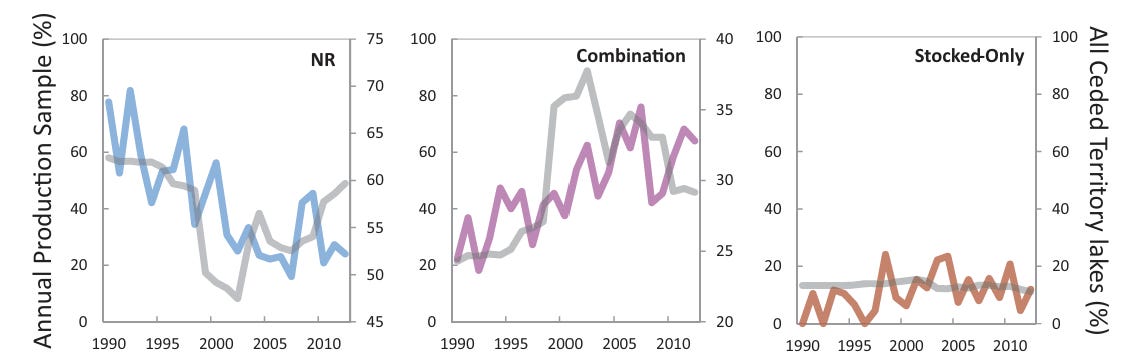
When a resource is extremely large, using it does not feel especially destructive. Catching a walleye from one lake surrounded by many other walleye lakes does not feel like overfishing. Cutting a tree from a seemingly endless forest doesn’t feel like deforestation. Shooting a few pigeons from a flock containing millions does not feel remotely connected to extinction risk.
And in isolation, it is true that none of those acts matter very much. It probably is sustainable. The problem is that a few birds become thousands, and thousands become millions. And because the population began at such an enormous size, the decline can remain invisible for a surprisingly long time.
In my field, fisheries science, we see versions of this pattern play out often, usually because we are looking at the wrong things. This is often termed “the invisible collapse”. My own research often finds something similar. Fish biomass remains about the same, but there are fewer babies and more old fish. Or perhaps the numbers are similar, but growth has slowed for some reason, maybe because of an invasive species. Bag limits are reduced, but because highly skilled fishers compensate, total harvest remains unchanged. The species is still there, but not in the same numbers. There are many ways we take our eye off the ball. In doing so, we don’t realize that the whole system is becoming more and more fragile.
There is an economic analogy here that I find useful. If you have enough money in various investment accounts, you can live indefinitely off the interest. But if your withdrawals begin exceeding the returns, eventually you start spending the principal. And we all know examples of people squandering fortunes because they lived beyond their means.
Natural resources work much the same way. A population can tolerate some level of impact because reproduction replaces losses. But once extraction consistently exceeds replacement, you are no longer harvesting the surplus.
You are eating your seed corn.
But nature sends no bank statement. There is no moment when the forest, fishery, aquifer, or pigeon flock screams - “hey you’re crossing the red line!” We have to calculate these things ourselves, and we have to be smart and patient to do so. But without the science, everything can still look okay for awhile. The nets are still full (yeah, maybe not as full). The trees are still standing. The wells are still pumping. There are still birds in the sky.
That may be one of the most dangerous things about abundance: it can be its own palliative, ironically lulling us into a false sense of safety, precisely when there is still time to do something about it.
Extinction
By 1860, people were already noticing passenger pigeon numbers dropping, yet commercial slaughter continued. In 1878, one of the last enormous nesting colonies, near Petoskey, Michigan, was still being harvested at a reported clip of about 50,000 birds per day for nearly five months. By the 1890s, however, the decline was painfully obvious. In 1897, Michigan legislators proposed a ten-year closed season on passenger pigeons, but by then the measure was effectively meaningless. There were too few birds left for protection alone to work.
By 1900, essentially no passenger pigeons remained in the wild. The hardest part of any ecological collapse is identifying the moment when the many become the few. Somewhere along the way, the passenger pigeon crossed from abundant to endangered. But where? Five billion? One billion? Five hundred million? One hundred million? There was no obvious threshold, and certainly no alarm announcing that the most abundant bird in North America entered the extinction spiral.
There were captive passenger pigeons in these days, and some attempts to breed them, but the efforts were small and came very late. One of the most important captive flocks belonged to David Whittaker in Milwaukee, my hometown. Whittaker successfully bred a small flock from birds captured in Wisconsin. Some of these birds were later transferred to zoologist Charles Otis Whitman in Chicago, who studied pigeons extensively and even experimented with hybridizing passenger pigeons with other species.


Martha, the bird that would ultimately become the last passenger pigeon, came from that dwindling captive world. Her exact birthplace is uncertain, although she was descended from captive birds associated with the Milwaukee and Chicago flocks. Eventually, the remaining birds were concentrated at the Cincinnati Zoo.
And eventually, there was only Martha.
She outlasted her final male companions, the last of which died in 1910. For the final four years of her life, the bird whose species once numbered in the billions was alone. And by then, the public understood what she represented. After all, there were many people at this time who were alive to see the extraordinary pigeon flocks.
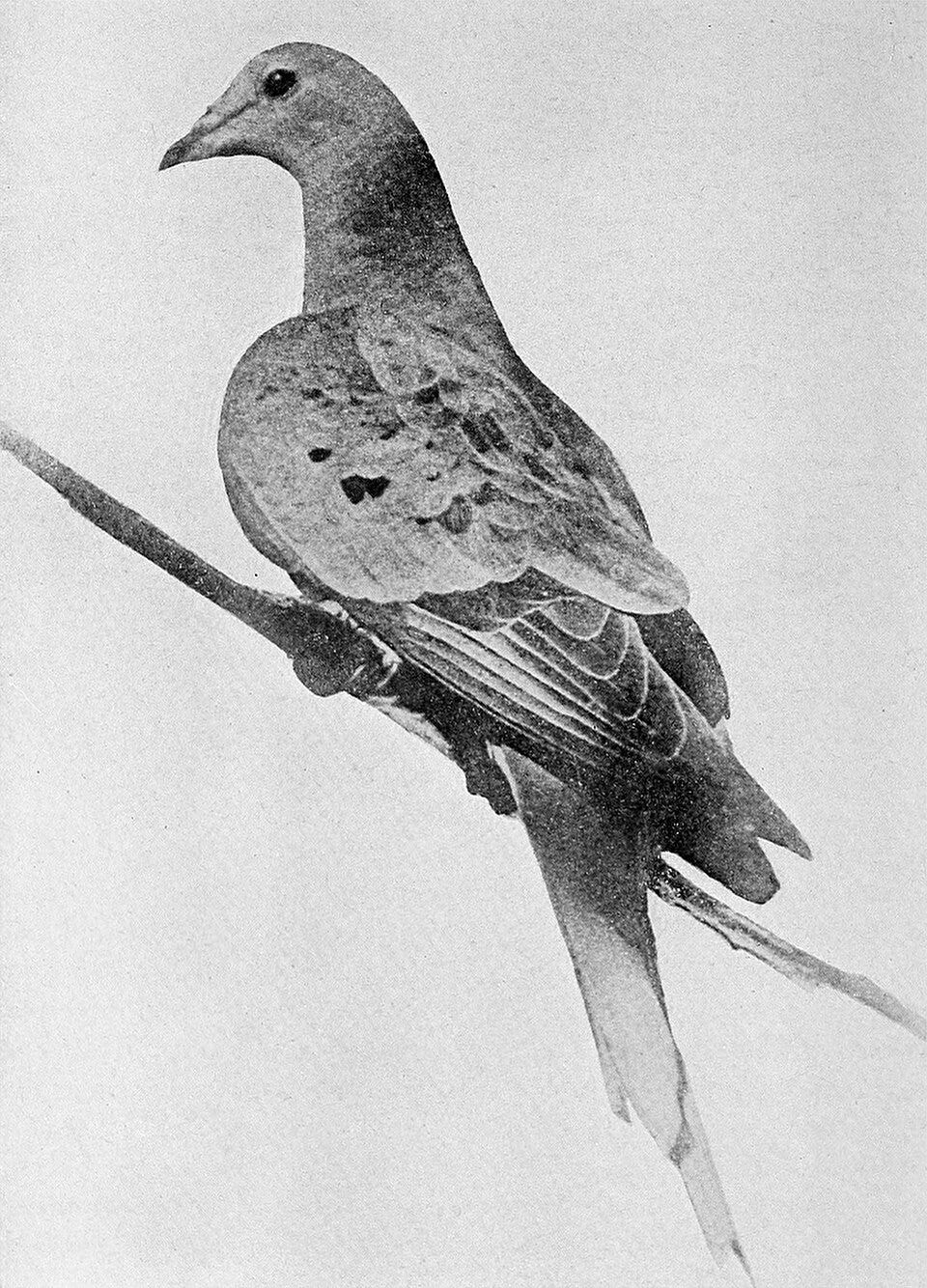
Ironically, just like the pigeons, visitors came in massive flocks to the Cincinnati Zoo to see her. And on September 1 (today’s date) in 1914, Martha was found dead on the floor of her cage. She was roughly 29 years old. Zoo staff froze her body in a 300-pound block of ice and sent her by train to the Smithsonian Institution in Washington, D.C., where she was preserved as a museum specimen.
Five billion to one. Then zero.
Mourning
“For one species to mourn the death of another is a new thing under the sun.” ~Aldo Leopold, writing on the dedication of the passenger pigeon monument
People weren't ready for this extinction. It was shocking and served as a much needed wake up call. And credit to the people at the time, they did some things about it.
The Lacey Act of 1900 was, in many ways, a belated federal response to the passenger pigeon catastrophe. For most of the nineteenth century, wildlife regulation was left to individual states, an approach poorly suited to migratory birds that routinely crossed state lines while their carcasses traveled by rail to distant markets. By the time Congress acted, passenger pigeons had already collapsed into scattered remnants.
The Lacey Act prohibited the interstate transport of wildlife taken illegally under state law, striking directly at the machinery of market hunting. It became an important turning point in federal wildlife conservation. But it came too late for the species that inspired it. It did however help many others - the buffalo, ducks, big game species.
“It is late. It is too late as to the wild pigeon. The buffalo is almost a thing of the past, but there still remains much to preserve, and we must act earnestly if we would accomplish good things.”~ Iowa Congressman, John Fletcher Lacey
On May 11, 1947, a stone monument to the passenger pigeon became an unusually public form of mourning for an extinct species at Wyalusing State Park in Wisconsin. Conceived by the Wisconsin Society for Ornithology in the early 1940s and delayed by World War II, the monument was finally completed and dedicated on Sentinel Ridge, a bluff overlooking the confluence of the Mississippi and Wisconsin rivers. It is modest, like the pigeon, and located at a fitting place. Immense flights of passenger pigeons once crossed the land here. And it is not terribly far west, as the pigeon flies, from the cherished bur oak patch of my youth mentioned earlier.


The bronze plaque commemorates the last passenger pigeon recorded in Wisconsin, shot near Babcock in September 1899. The monument states that the species disappeared by the “avarice and thoughtlessness of man.” The memorial is generally regarded as the first monument built specifically to an extinct species. There is something salient about that. Humans did not merely record the extinction, but created a place where future generations could stand and think about the bird they’d never see.
Never Forget the Pigeon
There are many reasons to care about the extinction of species. Some are selfish. Perhaps, for example, we are missing out today on the joy of seeing a flock of passenger pigeons. Or dare I say, even tasting them? After all, consuming animals is one of the best reasons to conserve them.
More critically, though, we always underestimate that which we don’t understand. And as I think you can see from this essay, we really don’t understand the ecology of what was lost here. We can make back-of-the-envelope calculations about the nutrient enrichment effects of billions of pigeons moving through our forests, but we really don’t know the ecology deeply, and probably never will.
There may even be boomerang effects we barely considered. There is an intriguing literature on the potential links between passenger pigeons and Lyme disease. Lyme disease, caused by borrelia bacteria and passed through ticks, is maintained in part through populations of small mammals such as white-footed mice. These rodents consume many of the same mast resources, especially acorns, that passenger pigeons once consumed in enormous quantities. Did removing billions of pigeons alter those food webs in ways that ultimately favored rodents, ticks, or disease transmission? Maybe. Maybe not. But the larger point is that when we remove something that abundant from an ecosystem, we should expect surprises that are difficult to anticipate in advance.
Aside from the selfish reasons to prevent extinction, there are also moral ones. Count me in the camp that thinks it is simply wrong to let species go extinct. I wrote about this in another Tangled Nature essay. Extinction is a pox on our species, and something we ought to be embarrassed by. Just as we are judging the people of the 1800s, someday our descendants will judge us.
What will they say about how we lived?
From my perspective, our performance is a mixed bag. On the one hand, we’ve done a better job than most think about stemming extinctions. There are some high profile successes: bald eagles, buffalo, California condor. The Endangered Species Act can work. Yet there are also many failures. I lived in California and worked on native fishes when Delta Smelt were effectively declared extinct in the wild. Several other species are headed the same way. That story is less about harvest than it is about wiping out habitat. I’ve written several other blogs (here and here) about freshwater species that have either gone extinct, or are headed that way. Take heed. These are bright red flashing lights about our footprint on the land, and its cumulative toll.
Allow me to also offer some of my own suggestions for preventing these kinds of situations in the future. (1) It would be good if we had sustainable management plans for any species upon which harvest occurs. Our current system does a good job of this for certain species, but not so much for others. (2) Defend the Endangered Species Act. It could certainly be improved, and we shouldn't be scared of doing that. But, we need a safeguard, an Alamo, to prevent extinction. In the US, the ‘ESA’ is it. If this law were on the books in 1880, we'd still have passenger pigeons. (3) Beware of the allure of de-extinction. Scientists identified the passenger pigeon as a candidate for de-extinction - that is using genome research, editing and cross-breeding with closely related relatives to bring a proxy of the species back. Here's the issue, it's not the same species, and I'm not sure Americans are ready to welcome back an untested proxy akin to what we once had. Issues with property and agricultural damage come to mind. There are many other questions, and we should rightfully be skeptical. I've also seen many examples from the fish world of stocking and various other engineered solution to declined populations. It almost never works, because you need good habitat first. Doesn't mean we shouldn't explore this, but I smell a money pit.
The passenger pigeon is a good reminder for all of us. Its story compels us to consider just how much we really know about the land, water, and ecosystems that surround us. Indeed, a throughline in my writing I keep returning to here is just how massively different our landscapes once were. On further inspection, our sense of ecological history can be terribly misguided, sometimes flat-out wrong. Often, I think, this is simply because we do not understand history very well.
When I think back on my time beneath those elder bur and white oaks, I am grateful. I gained a connection with nature there that few people will ever know. But now there is a sadness too. One I didn’t recognize when I was younger. Because I didn't know. Those trees were lonely in a kind of way.
A passenger pigeon had not roosted in their limbs in over a hundred years.
Go Deeper
Blockstein, D.E. 1998. Lyme disease and the passenger pigeon. Science 279: 1831.
Ellsworth, J.W., and B.C. McComb. 2003. Potential effects of passenger pigeon flocks on the structure and composition of presettlement forests of eastern North America. Conservation Biology 17: 1548-1558.
Embke, H.S., A.L. Rypel, S.R. Carpenter, G.G. Sass, D. Ogle, T. Cichosz, J. Hennessy, T.E. Essington, and M.J. Vander Zanden. 2019. Production dynamics reveal hidden overharvest of inland recreational fisheries. Proceedings of the National Academy of Sciences 116: 24676-24681.
Greenberg, K., K. Weeks, and G.S. Warburton. 2015. The historic role of humans and other keystone species in shaping central hardwood forests for disturbance-dependent wildlife. In C.H. Greenberg and and B.S. Collins (eds.). Natural disturbances and historic range of variation: Type, frequency, severity, and post-disturbance structure in central hardwood forests USA. Managing Forest Ecosystems, 2015, Vol. 32. 400pp.
Leopold A. 1949. A Sand County Almanac. Oxford University Press. Read especially the chapter titled “On a Monument to the Pigeon.”
A modified version of the essay can be found here: https://www.birdwatchingdaily.com/news/conservation/monument-pigeon-aldo-leopold/
Moyle, P. 2020. Eating Delta Smelt. California Waterblog.
Moyle, P., K. Börk, J. Durand, T.C. Hung, and A.L. Rypel. 2021. 2021: Is This the Year That Wild Delta Smelt Become Extinct? California Waterblog.
Post, J.R., M. Sullivan, S. Cox, N.P. Lester, C.J. Walters, E.A. Parkinson, A.J. Paul, L. Jackson, and B.J. Shuter. 2002. Canada’s recreational fisheries: the invisible collapse? Fisheries 27: 6-17.
Rypel, A.L., D. Goto, G.G. Sass, and M.J. Vander Zanden. 2018. Eroding productivity of walleye populations in northern Wisconsin lakes. Canadian Journal of Fisheries and Aquatic Sciences 75: 2291-2301.
Rypel, A.L., P. Saffarinia, C.C. Vaughn, L. Nesper, K. O'Reilly, C.A. Parisek, M.L. Miller, P.B. Moyle, N.A. Fangue, M. Bell-Tilcock, D. Ayers, and S.R. David. 2021. Goodbye to "rough fish": paradigm shift in the conservation of native fishes. Fisheries 46: 605-616 .
Rypel, A.L. and P.B. Moyle. 2024. Watching Native Fishes Vanish. California Waterblog.
Rypel, A.L. 2026. Five Cool Fishes That Went Extinct. Tangled Nature.
Schorger, A.W. 1955. The Passenger Pigeon: Its Natural History and Extinction. University of Wisconsin Press, Madison, Wisconsin. 424 pp.
Shufeldt, R.W. 1920. Published figures and plates of the extinct passenger pigeon. The Scientific Monthly.
Stimpson, A. 2025. The Mystery of the Mast Year. Cool Green Science.
The Passenger Pigeon. https://en.wikipedia.org/wiki/Passenger_pigeon
Project Passenger Pigeon. https://naturemuseum.org/cas/project-passenger-pigeon
Wisconsin And The Extinction Of The Passenger Pigeon. PBS Wisconsin.
I’m not religious but I often think of the biblical story of the quails in which the wandering Israelites complained so bitterly about the lack of food that god caused their camp to be inundated with quails. They immediately began stockpiling as much as they could until god struck some of them down for being greedy. Whether or not this captures an historical event, it certainly reflects an understanding of human nature when confronted by natural abundance, which I believe stems from a deep memory of periods of starvation. The behavior appears to be more instinctual than premeditated.
Aldo Leopold’s epitaphic essay for the passenger pigeon (and SCA writ large) remains as some of the best nature writing I have ever read. Thanks for putting this piece together, it’s a great yet sobering read. You had the Crawfish River off County Rd BB, I had my own muddy woodland off County Rd E on the Bark River. I hope Wisconsin can retain and protect its natural beauty for generations to come, so that our children may enjoy their own riparian copses.