
Ooze, Order & Disorder
A perspective on the complicated nature of nature

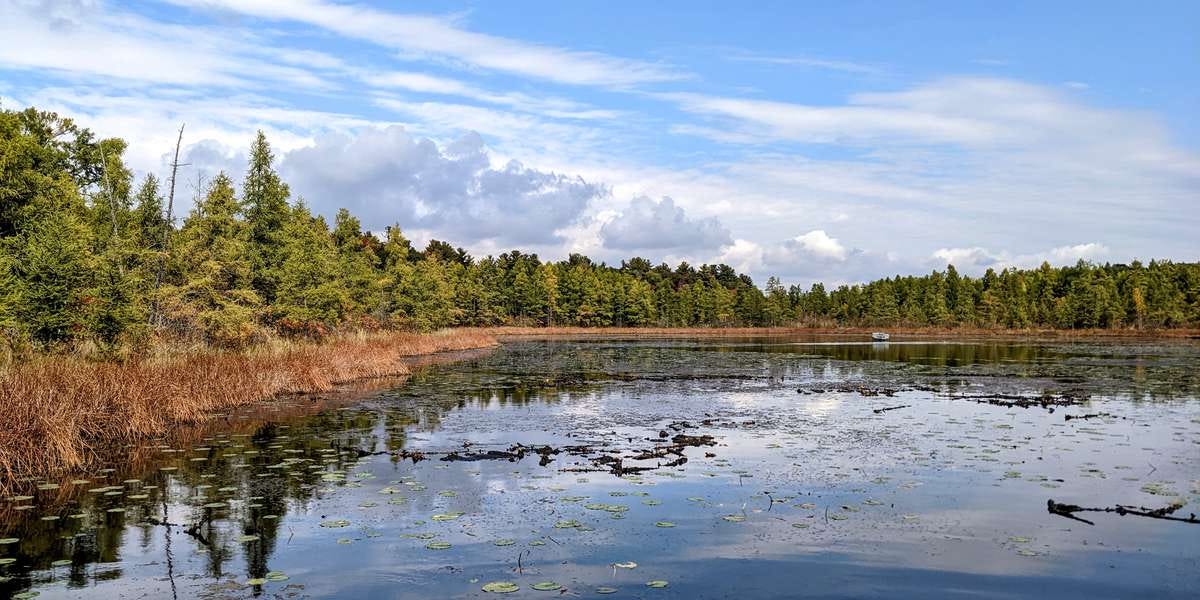
Raymond Lindeman died when he was just 26 years old. Yet somehow, this young scientist burned like a comet and produced something deep and true that transformed the field for generations. Lindeman was a “limnologist”, that is, a scientist who studies freshwater ecosystems. They are a type of ecologist, and I consider myself to be among their kind. Lindeman etched himself into the rarified pantheon of limnology royalty through a meticulous study of a teensy bog lake in Minnesota during the 1930s. Cedar Bog Lake is an ideal locale for limnology work. It has obvious boundaries, simple species, interesting seasonal dynamics, and is itself evolving over millennia as the lake slowly dies, like all lakes eventually do. I see why he was drawn to it.
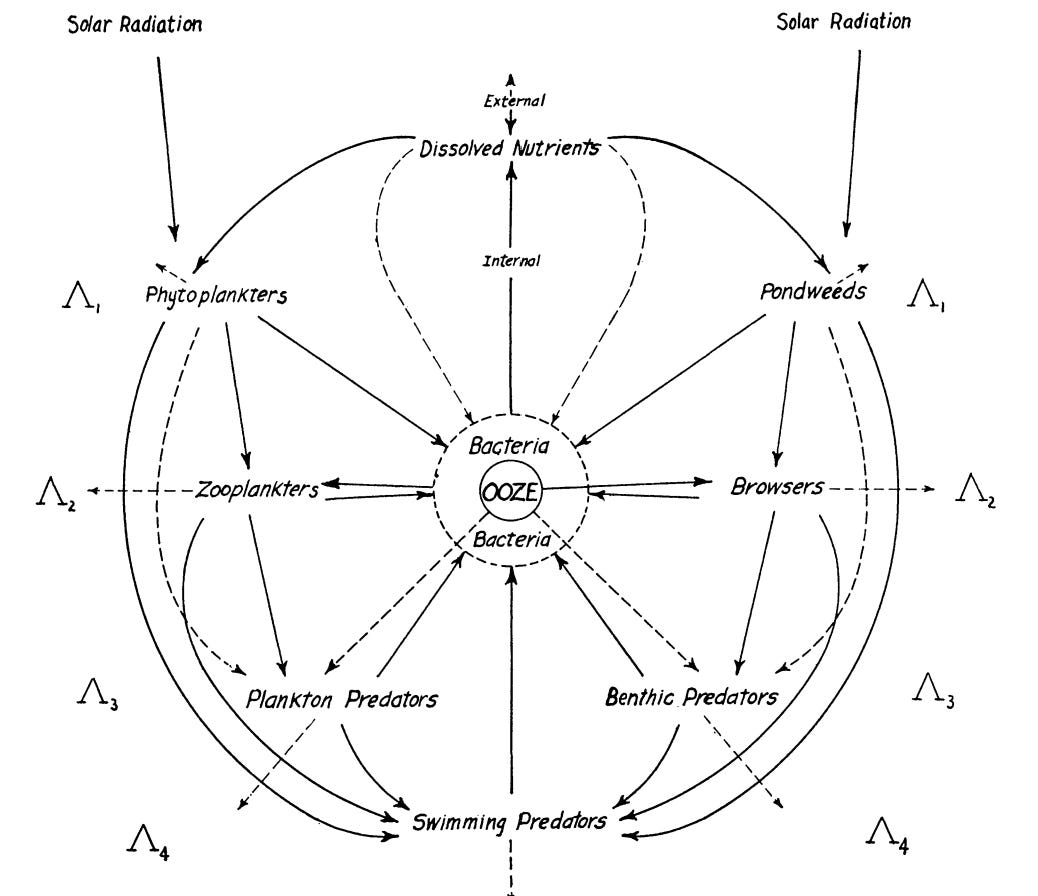
The key innovation was his unveiling of the lake as a series of trophic levels through which energy and materials flow. Carbon and nutrients are pulsing out from the ‘ooze’ and these materials are then animating the lake. But Lindeman didn't just imagine this reality - he actually measured it. Those weird little Greek symbols in Fig. 1 are energy transfer calculations made between different trophic levels of the lake. He took field measurements of all the compartments in the lake over time, and those are the measured fluxes. Incredible. Yet there is an even bigger point here. Lindeman tapped into some fundamental and catholic truths about our world, and us. That is, that the organisms and environment are linked - tangled together - in a kind of enigmatic dance beating rhythmically over the years towards something. He also suspected, accurately, that bacteria were at the center of the action. And while things themselves die, the carbon flows on, back to the ooze and bacteria, and back again into the lake.
Lindeman’s work marked the dawn of modern ecology, but it did not come together easily or fast. Field work occurred 1936-1941. And Lindeman toiled conceptually and personally on this work. When the manuscript was finally ready, it was rejected by the peer-reviewed journal Ecology (essentially the establishment) as being too theoretical. Stating the obvious: these were radical ideas for the era, maybe even today. Folks weren't ready. Ecologists during the 1930s primarily conducted descriptive studies. His rejected opus was reworked and championed by G. Evelyn Hutchinson, Lindeman’s new postdoc advisor at Yale (another influential and brilliant ecologist of the era). It is thought that Hutchinson pushed Lindeman to work out the signature energy transfer calculations as these were noticeably absent from prior iterations (Sterner 2012). When he fell sick, Lindeman’s wife, Eleanor, threw herself into the work, contributing what might be enough to warrant authorship by today's standards. The journal ultimately changed its mind, and to their credit, published Lindeman's opus, but posthumously after Lindeman’s untimely death in 1942, probably from hepatitis.
With some professional perspective now, I can see how raw fearlessness was also a key ingredient to the Lindeman story. The safe move at the time would've been another descriptive study of the lake. Instead, Lindeman confronted the complex tangled nature of nature, and through hard work, produced something rare, deep, and true. This leads me to earnestly ask: are we approaching ecology and science today with the audacity of a Lindeman? Perhaps not. Get the truth serum in an ecologist, and most would admit that grim truth. Even though Lindeman left us a stunning window into the complex architecture of our world, we've probably not done enough with it. Currently, some of our best minds, rather than working to improve our world, seem bent on pursuing safe and idiosyncratic ideas (Bregman 2025). In an extreme example, though one that illustrates the point: creating ostensibly anodyne phone apps that distract and collect private information on us so that others can sell us stuff. Inside STEM specifically, studies show we are definitely growing less innovative (German and German 2016, Park et al. 2023). But why? We have access to technology and tools that scientists in the 1930s would drool over. Yet here we are, still largely perplexed by the complexity of ecosystems. There has never been a Nobel Prize awarded to an ecologist. Is that because ecology is a less rigorous field than physics, chemistry or mathematics? Is it because ecology is inherently hard and ecosystems express an unmatched degree of complexity? Have we ignored key perspectives? Or do we (hard as this is to write) lack the imagination, moxie and grit to pursue outstanding science in this realm? I don't know the answers, but I think we should be open to the possibilities and medicines, even if we don't like the taste.
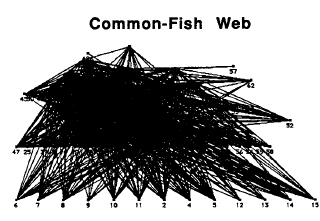
Our inability to disentangle the web of nature is especially apparent in our rudimentary understanding of large speciose environments. Take for example, the food web of this large South American river described by Kirk Winemiller in 1990 (Fig. 2). In this case, Winemiller dissected thousands of fish stomachs to create this web. But, there are so many interactions occurring here that you can't even see them all! Furthermore, Winemiller showed that these patterns change significantly in different rivers and over time in the same river. I have wondered from time-to-time about Winemiller’s thought process with this study. Was this an announcement to ecologists? To get off their fannies and back into the game? To encourage more people to follow Lindeman into the interwoven tapestry of nature and the ooze? This interview with Winemiller provides some useful nuance. During the 1980s, there were many theoretical studies of food webs using ‘fake data’ or extremely simple webs. Yet these theoretical studies were outpacing the intake of information on real food webs, probably because the real data are so hard to get. The paper was effectively poking holes in that theoretical work because it wasn't based on any degree of complexity endemic to nature. Winemiller, it seems, was saying we need rigorous lines of evidence (real observations, experiments, models and probably also theory) to effectively peel apart the many layers of nature.
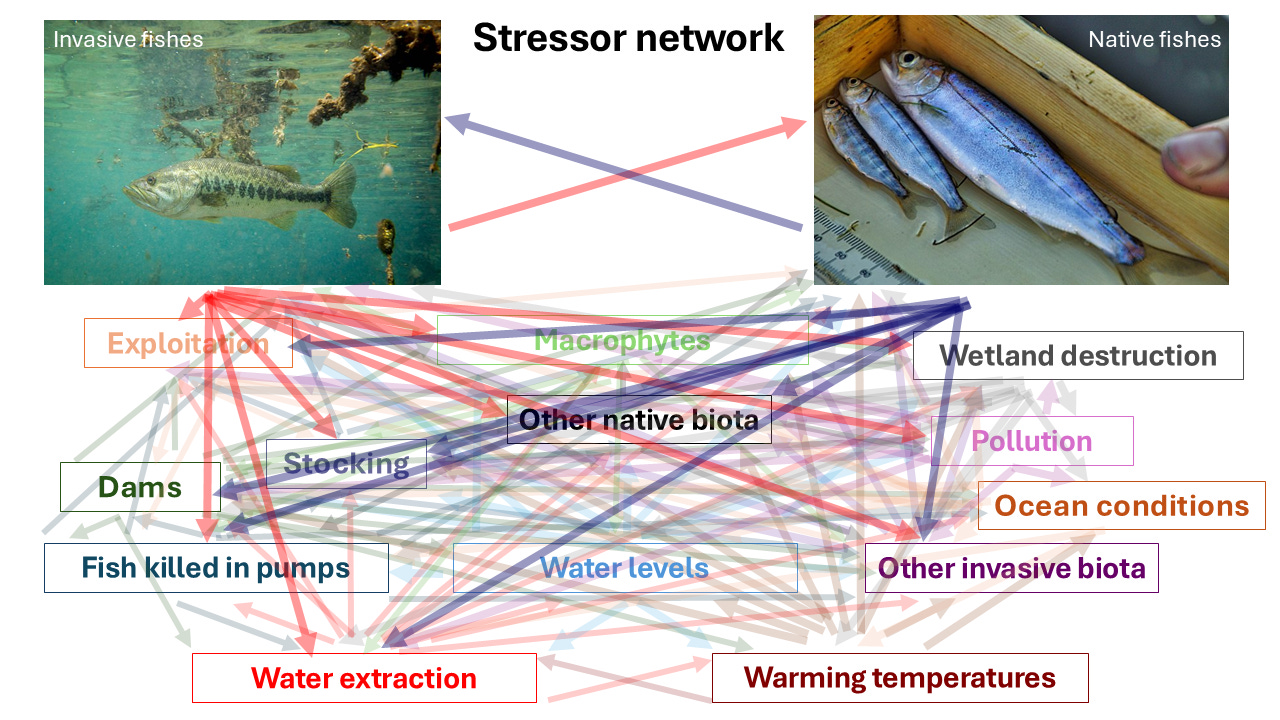
Added to this hot mess is the unambitious domination of Earth by humans. We need to understand those impacts too, often simultaneously, so that we can manage our natural resources better. For the last 8 years, I studied the decline of native fishes in California. A stunning 83% of native fishes in the region face extinction, including most of the salmon (Rypel 2023, Rypel and Moyle 2024). At the same time, invasive fishes are ascendant throughout the region. These changes seem to have intensified, especially since the 1970s, a period during which the human population doubled from 20M to 40M people. The fishes tell us much about our watersheds and how we manage them. The fishes are, in many ways, passengers of broader environmental change. As the ecosystems go, so too do the fishes. Thus the native species are declining primarily because their ecosystems are declining. Finding the pressure points for arresting these declines is really hard though and requires focus. Below, I sketched a map of the many stressors in this question and how they can all interact. Just like the other examples, humans, fish, and the environment are linked together, only this time in a dance of destruction.
So, Lindeman was right, about a great many things. Nature is inherently tangled and complicated. It is perhaps for these reasons that Darwin himself, long before Lindeman, used the metaphor of nature as a ‘tangled bank’. If we want to unlock the secrets of nature, we must be willing to confront the reality of biocomplexity. This is hard and intellectually challenging work, but critical for survival of our species. There is also great complexity rooted within each of us, encompassing our psychologies, relationships, and social traditions. EO Wilson wrote of ‘Biophilia’ or human’s attraction to nature (Wilson 1985). “Humanity is part of nature, a species that evolved among other species. The more closely we identify ourselves with the rest of life, the more quickly we will be able to discover the sources of human sensibility and acquire the knowledge on which an enduring ethic, a sense of preferred direction, can be built.” Indeed, we are all complicated and deeply connected to nature in our own ways - Lindeman was. I’ve learned over the years that I certainly am. We are all tangled up together, inside and outside the ooze. Sometimes, our behaviors make little sense to others. Each of us have our own histories - our own tangled patterns of succession - of failure, scars, and success. That's part of what makes the Lindeman story so compelling.
These are the themes that I want this substack to be about. If you too are interested in stories and ideas about these topics, I hope you find a little home here. Let us explore nature together. New writings should come out once a month, and if things go well, perhaps more.


Go deeper
https://en.wikipedia.org/wiki/Raymond_Lindeman
https://reflectionsonpaperspast.wordpress.com/2020/09/29/revisiting-winemiller-1990/
Bregman, R. 2025. Moral Ambition: stop wasting your talent and start making a difference. Little, Brown and Company.
German, D., and S. German. 2016. Science in the age of selfies. Proceedings of the National Academy of Sciences 113: 9384-9387.
Lindeman, R.L. 1942. The trophic-dynamic aspect of ecology. Ecology 23: 399-417.
Park, M., E. Leahey, and R.J. Funk. 2023. Papers and patents are becoming less disruptive over time. Nature 138-144.
Rypel, A.L. and P.B. Moyle. 2024. Watching native fishes vanish. https://californiawaterblog.com/2024/09/01/watching-native-fishes-vanish/
Rypel, A.L. 2023. Facing the dragon: California’s nasty ecological debts. https://californiawaterblog.com/2023/06/11/facing-the-dragon-californias-nasty-ecological-debts/
Sterner, R.W. Raymond Laurel Lindeman and the trophic-dynamic viewpoint. Limnology and Oceanography Bulletin 21: 38-51.
Wilson, E.O. 1986. Biophilia: the human bond with other species. Harvard University Press.
Winemiller, K.O. 1990. Spatial and temporal variation in tropical fish trophic networks. Ecological Monographs 60: 331-367.